Reading Chinese news can feel intimidating. Many learners assume they must know thousands of characters before they can read articles comfortably (and that’s not completely untrue). But the real barrier is not just vocabulary size, but also reading strategy.
I’ve made the point before that reading the Chinese news is easier than most learners of Mandarin think, because apps and tools are available that make “raw” Chinese news articles more accessible to learners of various levels. For example: with ChatGPT or Gemini you can simplify almost any piece of news to a level that is comfortable for you to read.
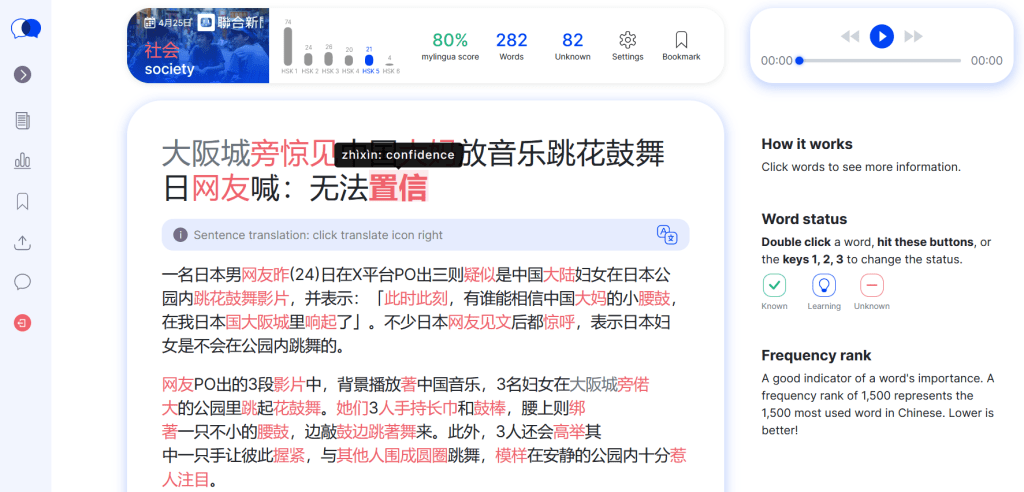
Reading the Chinese news with Mylingua
But let’s forget about AI-tools for learning Chinese, Chairman’s Bao, Easy Chinese News and other apps. What about an actual reading method that will allow you to crack Chinese headlines without looking at images for clues?
Native Chinese readers don’t read news character by character (and neither do we in our native language(s)). Instead, they scan quickly for phrases, verbs, and key information. Once you learn to imitate this approach, you can often read Chinese news three to five times faster – even as an intermediate learner.
Let’s look into this practical method and break it down step by step.
Why Chinese news is actually easier than you think
Chinese news writing is highly structured and repetitive. Journalists tend to reuse the same patterns, verbs, and phrases across articles. This means once you learn the most common structures, you can quickly understand the core of many news stories (and skip such patterns).
Compared with novels or essays, news articles typically feature:
predictable sentence structure
repetitive vocabulary
concise headlines
key information placed at the beginning
Because of this consistency, Chinese news is ideal for training efficient reading habits.
A powerful trick: phrase-first reading
The biggest shift learners need to make is moving from character-by-character reading to phrase-based reading.
Many learners read like this:
character → character → word → sentence
Native readers process Chinese more like this:
phrase → meaning → move on
Consider this sentence:
中国政府宣布新的经济政策以促进增长。
A beginner might read it character by character:
中国 / 政府 / 宣布 / 新的 / 经济 / 政策 / 以 / 促进 / 增长
But a faster reader sees four meaningful chunks:
中国政府 (Chinese government)
宣布 (announce)
新的经济政策 (new economic policy)
促进增长 (promote growth)
Instead of processing nine separate items, your brain processes four meaningful units. This dramatically speeds up reading.
Step 1: Start with the headline
Chinese headlines are extremely condensed. They usually contain the most important information in the entire article.
For example:
欧盟批准新贸易协议
A quick breakdown reveals everything you need:
欧盟 – European Union
批准 – approve
贸易协议 – trade agreement
Within seconds, you already understand the story.
Step 2: Skip the source line
Many Chinese news articles begin with attribution phrases such as:
据新华社报道
据路透社报道
据媒体报道
These phrases mean “according to Xinhua,” “according to Reuters,” or “according to media reports.” While useful for journalistic attribution, they rarely add meaningful information for the reader.
Efficient readers often skip these lines entirely.
Step 3: Focus on information words
Chinese sentences contain both information words and structure words.
Information words include:
nouns (政府, 市场, 政策)
verbs (宣布, 调查, 支持)
Structure words include characters like:
的 · 了 · 在 · 对 · 将 · 与
These structural elements help grammar but often contribute little to understanding the core message.
For example:
政府将对市场采取新的监管措施。
Instead of reading every character, focus on the key information:
政府 → 市场 → 监管措施
The meaning becomes clear very quickly.
Step 4: Hunt for the action verb
In news writing, the verb reveals what actually happened.
Once you spot the verb, the rest of the sentence becomes easier to interpret.
Common Chinese news verbs include:
宣布 (xuānbù) — announce
批准 (pīzhǔn) — approve
呼吁 (hūyù) — call for
调查 (diàochá) — investigate
通过 (tōngguò) — pass (a law or proposal)
批评 (pīpíng) — criticize
支持 (zhīchí) — support
For instance:
政府宣布新的政策
Once you see 宣布, you already understand the structure:
someone announced something.
Step 5: Jump to numbers
Numbers often carry the most important information in a news story.
For example:
经济增长率达到6.3%。
Even if you skim the sentence, the number 6.3% immediately tells you the key statistic.
Native readers instinctively scan for numbers because they summarize results, trends, or scale.
Step 6: Ignore names at first
Names can slow reading significantly, especially for learners unfamiliar with transliterations.
For example:
德国总理朔尔茨表示…
You can initially read it as:
德国总理 → 表示
That is enough to understand:
“the German chancellor said…”
You can always return to the name later if it matters.
A real example of fast reading
Consider this sentence:
中国政府周三宣布新的经济刺激计划,以促进经济增长。
Instead of reading every character, identify the core chunks:
中国政府
周三
宣布
经济刺激计划
促进增长
Within seconds, you understand the full meaning:
the Chinese government announced a stimulus plan to boost growth.
The 10-second news method
You can understand most news articles quickly by following a simple routine:
Read the headline
Read the first sentence
Scan for numbers
Scan for verbs
This process often reveals 80% of the story in under ten seconds.
Practice exercise
A simple exercise can train your brain to recognize key information quickly.
Take a short paragraph and:
circle the verbs
underline the nouns
ignore everything else
Examples:
中国政府 宣布 新的 经济政策,以 促进 增长。
欧盟领导人呼吁加强国际合作应对气候变化。
By focusing on the “meaning skeleton” of the sentence, your brain learns to process Chinese more efficiently.
Why this method works
Chinese news writing follows an inverted pyramid structure: the most important information appears first. This allows readers to grasp the core message almost immediately. Once you shift from decoding characters to recognizing phrases and patterns, your reading speed increases naturally.
HSK 4 – or even better, HSK 5 – should provide a solid foundation for reading Chinese news. Naturally, the vocabulary you actually need depends entirely on the topic. However, I do think you could create a top 100 list of “most common words” in Chinese news articles. Below, I have made a start compiling a list of frequently used vocabulary.
Speed reading the Chinese news
Reading Chinese news quickly isn’t about memorizing thousands of characters. It’s about switching off “I want to understand every detail” reading mode and knowing what clues to look for. I’m not saying this will change everything, but when you focus on phrases, verbs, numbers, and structure, you begin to read Chinese the way native readers do – by scanning for meaning rather than decoding every symbol. With practice and sticking to those articles you have a natural interest for, what once felt slow and overwhelming can become a pretty efficient way to stay informed while improving your Chinese.
Thanks for reading. Let me know if this method works for you and if you have other tricks or techniques to tackle Chinese news articles.
Affiliate links
Disclosure: These are affiliate links. They help me to support this blog, meaning, at no additional cost to you, I will earn a small commission if you click through and make a purchase.