Are you ready for the dynamic and culturally rich Year of the Horse arriving in 2026?
This is more than a simple change on the calendar—it’s a gateway into deep-rooted Chinese traditions and practical language patterns you’ll encounter in real life.
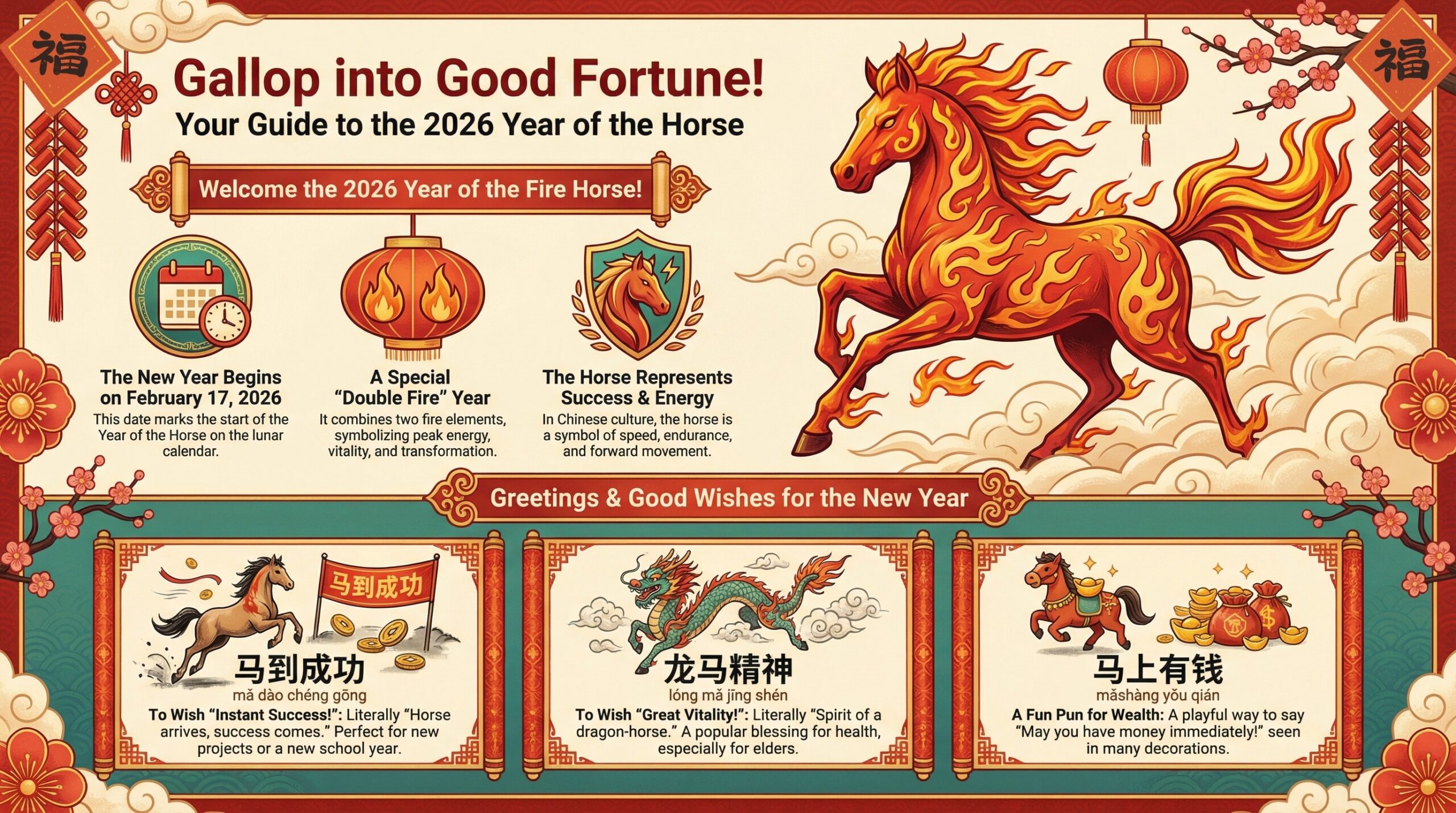
In 2026, we enter the Year of the Fire Horse (丙午年 – Bǐngwǔ nián), a rare combination that occurs only once every 60 years. It is often described as a “double fire” year, associated with peak 阳 (yáng) energy—symbolizing vitality, momentum, and transformation.
1. Cracking the “Time Code”: Why 2026 is Special
2. From Pictogram to Ink: The Visual Evolution of “马” (mǎ)
3. Horse Idioms (成语 – Chéngyǔ) to Boost Your Fluency
4. Playful Puns and Daily Life
5. Your 2026 Learning Challenge
1. Cracking the “Time Code”: Why 2026 is Special
The traditional Chinese calendar, commonly called the lunar calendar, aligns the phases of the moon with the solar year. Because a lunar year is about 11 days shorter than a solar year, the date of Chinese New Year shifts each year on the Gregorian calendar.
Key facts for 2026
The Start Date: The Year of the Horse officially begins on February 17, 2026.
The “丙午” Combination: 2026 pairs the Heavenly Stem “丙” (bǐng), which represents Yang Fire, with the Earthly Branch “午” (wǔ), which represents the Horse.
Double Fire symbolism: In Five Elements theory, both Bing and Wu belong to the Fire element. This creates what is sometimes called the “Red Horse” (赤马 – chìmǎ), associated with intensity, breakthroughs, and high energy.
Before the big day arrives, it helps to be prepared. You might enjoy this guide to essential preparations for the Spring Festival, or explore 8 things you might not know about Chinese New Year to better understand how the holiday really works.
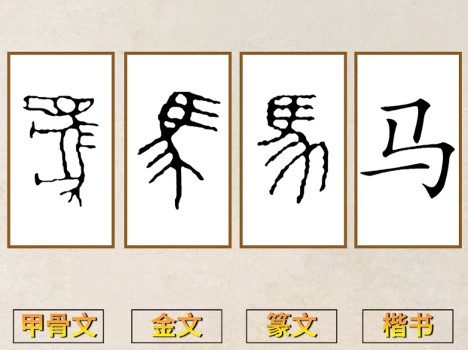
2. From Pictogram to Ink: The Visual Evolution of “马” (mǎ)
One of the most effective ways to learn Chinese characters is to explore their visual origins. The character 马 (mǎ) is a classic pictogram, originally designed to resemble the animal itself. In its earliest form, Oracle Bone Script (甲骨文), the character was a literal drawing of a horse with a long mane and four legs. Over thousands of years, the character was “tamed” and straightened into Seal Script before being simplified into the modern version we use today.
Linguistic Insight
You’ll often see 马 used as a phonetic component in other characters, helping indicate pronunciation rather than meaning:
妈 (mā): Mother (女 Woman + 马 Horse as the phonetic cure)
蚂 (mǎ): Ant (虫 Insect + 马 Horse)
Recognizing this pattern makes character learning far more efficient.
3. Horse Idioms (成语 – Chéngyǔ) to Boost Your Fluency
In Chinese culture, the horse is closely associated with success, speed, loyalty, endurance, and forward movement. These ideas appear frequently in idioms you’ll hear in daily life, business, and festive greetings.
Here are some of the most useful and positive horse-related expressions to know:
马到成功 (mǎ dào chéng gōng)
Literal: The horse arrives, and success comes immediately.
Usage: Use this to wish someone instant success at the start of a new endeavor, project, or semester.
祝你新项目马到成功!(Zhù nǐ xīn xiàngmù mǎdàochénggōng!)
Wishing you immediate success with your new project!
龙马精神 (lóng mǎ jīng shén)
Literal: The spirit of a dragon-horse.
Usage: This describes someone full of vitality and vigor. It is a common blessing for health and energy, especially for elders.
祝您身体健康,龙马精神!(Zhù nín shēntǐ jiànkāng, lóngmǎ jīngshén!)
Wishing you good health and great vitality!
一马当先 (yī mǎ dāng xiān)
Literal: To be the first horse at the front.
Usage: Use this to praise someone who takes the lead or shows great initiative.
在团队里,她总是一马当先。(Zài tuánduì lǐ, tā zǒng shì yīmǎdāngxiān.)
She always takes the lead in the team.
老马识途 (lǎo mǎ shí tú)
Literal: An old horse knows the way.
Usage: This phrase honors experience and wisdom, implying that a seasoned person can guide others through difficult paths.
A: 这件事会不会太复杂?(Zhè jiàn shì huì bù huì tài fùzá?)
Could this be too complicated?
B: 别担心,老马识途。(Bié dānxīn, lǎo mǎshítú.)
Don’t worry—experience will guide us.
千里马 (qiān lǐ mǎ)
Literal: A thousand-mile horse.
Usage: This refers to a person of exceptional talent who may be waiting for the right mentor to discover them.
他是千里马,只是还没遇到伯乐。(Tā shì qiānlǐmǎ, zhǐshì hái méi yù dào bólè.)
He’s extremely talented—he just hasn’t met the right mentor yet.
4. Playful Puns and Daily Life
Chinese culture loves wordplay, and the Year of the Horse offers perfect opportunities for festive puns using 马上 (mǎshàng). While 马上 literally means “on horseback,” it is most commonly used to mean “immediately.”
马上有钱 (mǎshàng yǒu qián): May you have money immediately!
马上有福 (mǎshàng yǒu fú): May good fortune come at once!
These playful expressions are especially popular in decorations, social media posts, and holiday greetings.
The Zodiac in Social Interaction
A natural way to ask someone’s age in Chinese is by asking their zodiac sign: “你属什么?” (Nǐ shǔ shénme?). If they reply “我属马” (Wǒ shǔ mǎ), they are born in a Year of the Horse (e.g., 1978, 1990, 2002, 2014, 2026) and are traditionally thought to be cheerful, quick-witted, and free-spirited.
If you were born in one of those years, 2026 is your Běnmìngnián (本命年), or zodiac year. While it’s a year of celebration, tradition suggests it can also be a time of challenges. To ensure a smooth gallop through your own year, learn how to bring yourself good luck on your Běnmìngnián.
5. Your 2026 Learning Challenge
The Year of the Fire Horse is a gallop, not a stroll; it rewards action and initiative. To truly embrace the spirit of 2026, try these activities:
Bless a Friend
Use the phrase “祝你龙马精神,马上有福!“ (Zhù nǐ lóngmǎ jīngshén, mǎshàng yǒu fú!) to wish them a double dose of good fortune.
Set a Goal
Write down your Chinese study goals and add: “希望我的中文学习马到成功!“ (I hope my Chinese studies meet with instant success!).
Explore Art
Look up 昭陵六骏 (the Zhaoling Six Steeds) or the ink paintings of 徐悲鸿Xu Beihong to see how the horse became a symbol of strength and perseverance.
By understanding the language and symbolism of the Year of the Horse, you’re not just learning festive vocabulary—you’re learning how Chinese culture connects time, imagery, and expression into a living system.
May you gallop into 2026 with clarity, confidence, and 龙马精神.
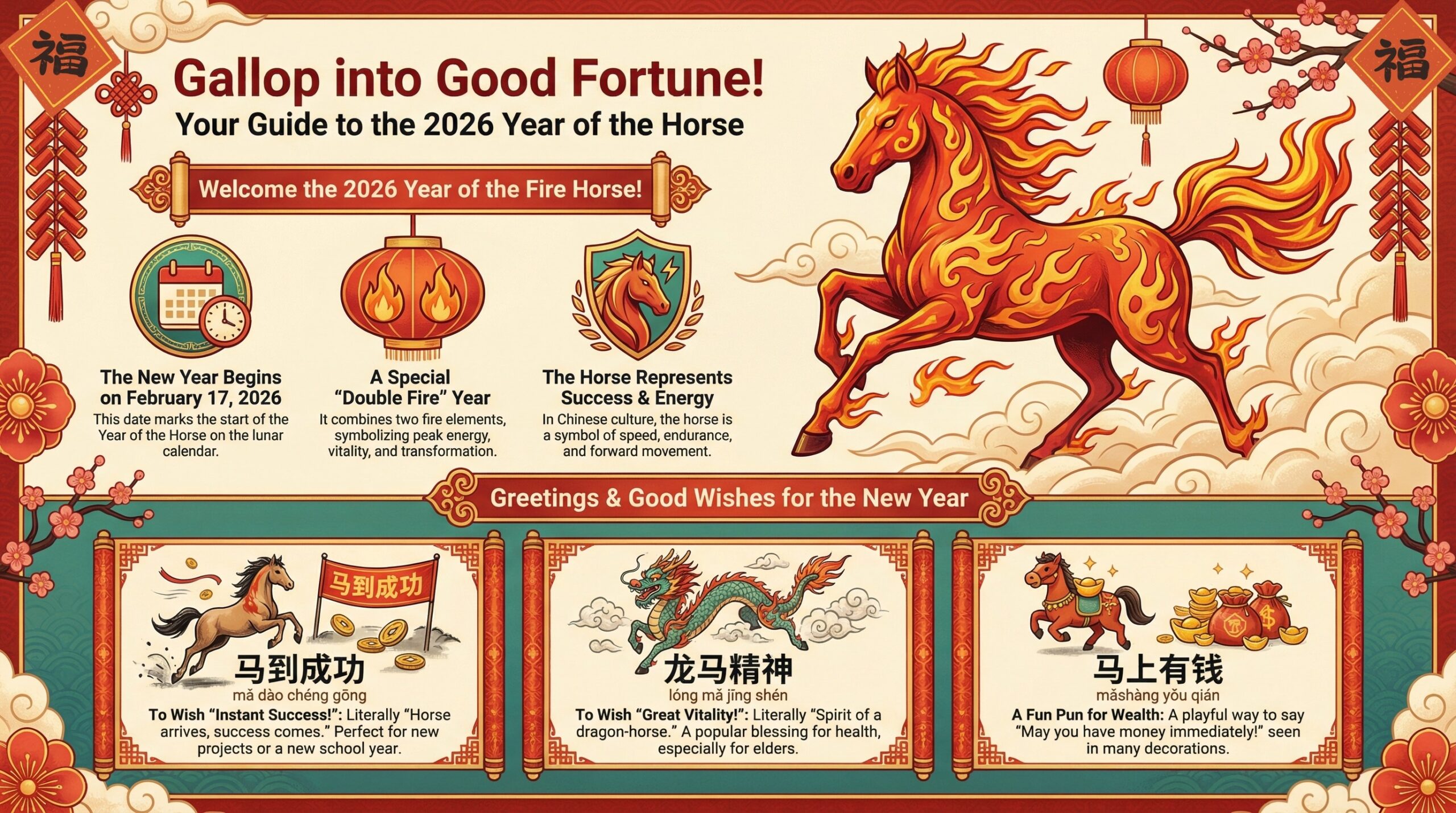
If you’d like a clean, printable, and visual version of everything covered in this article—from the Fire Horse time code to idioms and cultural insights—you can download the full PDF below.
The post Galloping into the Fire: Your Comprehensive Cultural and Linguistic Guide to the 2026 Year of the Horse appeared first on .