
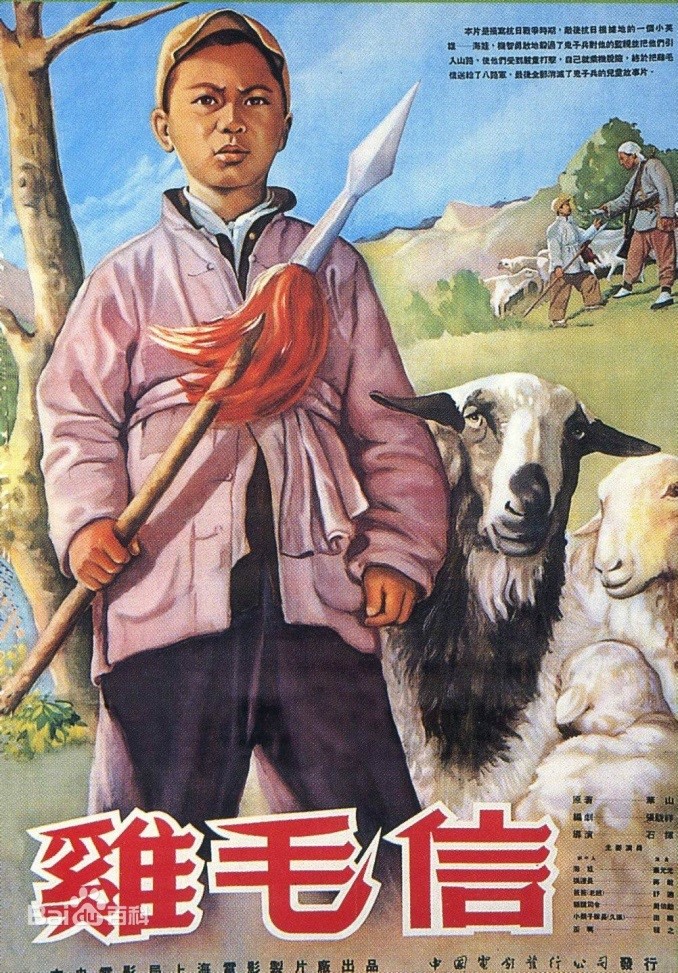
I’ve got a real treat for you today. Today’s post summarizes 《鸡毛信》, The Chicken Feather Letter, a classic Communist children’s novel written by Chinese author Hua Shan (real name Yang Huaning) in July 1945, while he was working as a war correspondent for Xinhua News Agency embedded with anti-Japanese resistance forces in northern China. It was first published in the inaugural issue of the literary journal 《长城》. After the founding of the People’s Republic in 1949, the story was included in school textbooks and became one of the most widely read pieces of children’s literature in China, later adapted into comic books, propaganda posters, and other formats. In 1954,it was made into a film — China’s first children’s war movie — which went on to win an award at the Edinburgh International Film Festival in 1955.
The Chicken Feather Letter tells the story of the twelve-year-old hero Hai Wa, a shepherd boy and children’s militia leader, who is entrusted with delivering an urgent secret letter to the Eighth Route Army, and must get there despite meeting great challenges along the way. The below text is not the original story, which is slightly too long for an Intermediate post here, but is a summarized version of the longer original tale. If you want to read the original book, you can find it on Amazon. If you can make it through this post, you can make it through the original as well.
Warning: This was written during the Sino-Japanese War, and as such, it includes historical language that is considered offensive today. Japanese soldiers are referred to as “Japanese devils” (日本鬼子) throughout the book, as they would have been referred to at the time.
Key vocab
民兵 – mínbīng – militia
放哨 – fàngshào – to stand guard, to keep watch
紧急 – jǐnjí – urgent, emergency
若无其事 – ruòwúqíshì – as if nothing happened
搜身 – sōushēn – to search someone’s body
迷路 – mílù – to get lost
游击队 – yóujīduì – guerrilla forces
炮楼 – pàolóu – blockhouse, gun tower
勇敢 – yǒnggǎn – brave, courageous
鸡毛信
那是抗日战争的时候。在华北的一个小村子里,住着一个十二岁的男孩,叫海娃。他的父亲老赵是村里的民兵队长。海娃每天的工作是放羊,同时帮村里放哨——如果看到日本鬼子来了,就赶快通知村里的人。
有一天,父亲把海娃叫来,交给他一封非常重要的信。信封上插着几根鸡毛。在那个时候,鸡毛信的意思是:这封信非常紧急,必须马上送到。父亲说:”你把这封信送给山那边的八路军张连长。记住,不管发生什么事,这封信不能落到鬼子手里。”
海娃点点头,把信放进衣服里,赶着羊出发了。
但是他刚走进山谷,就看到前面来了一队日本士兵。海娃非常害怕。他想,如果鬼子搜他的身,一定会找到信。他看了看身边的羊,突然想到了一个办法。他把信藏在了一只大羊的尾巴下面,然后若无其事地继续走。
鬼子拦住了他,搜了他的身,什么都没有找到。但是鬼子没有放他走——他们抢了他的羊,还逼他带路去龙门村。海娃没有办法,只能跟着鬼子走。
晚上,鬼子住在一个山庄里。海娃睡不着,他一直在想那封信。半夜,等鬼子都睡着了,他悄悄地从羊群里取出信,然后慢慢地爬向门口。外面很黑,很冷。海娃跑了起来。
但是天还没有亮,他就在山里迷路了。他又累又冷,不知道该往哪里走。天亮以后,鬼子发现他跑了,开始追他。就在这个时候,海娃看到了山上有八路军的士兵。他大声喊:”八路军!我有鸡毛信!”
但是就在这时,一颗子弹打中了他的手。海娃倒下了,但是他没有松开那封信。
八路军士兵跑下来,把他救了。海娃把信交给了张连长,然后晕了过去。
根据信里的情报,八路军和游击队一起炸毁了鬼子的炮楼,打了一场大胜仗。
海娃醒来的时候,张连长坐在他旁边,笑着说:”你是一个勇敢的好孩子。”
海娃看了看自己受伤的手,笑了。
The Chicken Feather Letter
This happened during the War of Resistance Against Japan. In a small village in North China, there lived a twelve-year-old boy named Haiwa. His father, Old Zhao, was the captain of the village militia. Haiwa’s daily job was to herd sheep while also keeping watch for the village – if he saw Japanese devils coming, he would quickly warn the villagers.
One day, his father called Haiwa over and gave him a very important letter. Several chicken feathers were stuck in the envelope. At that time, a chicken feather letter meant: this letter is extremely urgent and must be delivered immediately. His father said: “Take this letter to Eighth Route Army Company Commander Zhang on the other side of the mountain. Remember, no matter what happens, this letter cannot fall into the devils’ hands.”
Haiwa nodded, put the letter inside his clothes, and set off driving his sheep.
But just as he entered the valley, he saw a group of Japanese soldiers coming toward him. Haiwa was very scared. He thought, if the devils search him, they would definitely find the letter. He looked at the sheep beside him and suddenly thought of an idea. He hid the letter under a big sheep’s tail, then continued walking as if nothing had happened.
The devils stopped him and searched him but found nothing. However, the devils didn’t let him go – they took his sheep and forced him to lead the way to Longmen Village. Haiwa had no choice but to follow the devils.
That night, the devils stayed in a mountain village. Haiwa couldn’t sleep; he kept thinking about that letter. At midnight, when the devils were all asleep, he quietly retrieved the letter from among the sheep, then slowly crawled toward the door. It was very dark and cold outside. Haiwa started running.
But before dawn, he got lost in the mountains. He was exhausted and cold, not knowing which way to go. After daybreak, the devils discovered he had escaped and started chasing him. Just then, Haiwa saw Eighth Route Army soldiers on the mountain. He shouted loudly: “Eighth Route Army! I have a chicken feather letter!”
But at that moment, a bullet hit his hand. Haiwa fell down, but he didn’t let go of that letter.
Eighth Route Army soldiers ran down and rescued him. Haiwa handed the letter to Company Commander Zhang, then fainted.
Based on the intelligence in the letter, the Eighth Route Army and the guerrillas together blew up the devils’ blockhouse and won a great victory.
When Haiwa woke up, Company Commander Zhang was sitting beside him, smiling and saying: “You are a brave and good child.”
Haiwa looked at his injured hand and smiled.